
PPC management pricing is confusing on purpose. Some agencies charge a percentage of your ad spend, some a flat monthly fee, some both, and many hide setup costs. Here is how the main models work, what a fair service should include, and how to tell if your account is being managed at all.
Key takeaways
- Ad spend and management fees are separate. You pay the ad platform directly.
- Flat fees are easier to budget. Percentage fees grow with your spend.
- A good manager works on search terms, ads and tracking every week.
- Conversion tracking must be set up before any optimisation means anything.
Ad spend vs management fee
Your ad spend is what you pay Google or Meta for clicks. The management fee is what you pay someone to run the account. Keep them separate: ads should be billed to your own card, in your own account, so you always keep the data and the history.
Common pricing models
| Model | How it works | Watch out for |
|---|---|---|
| Percentage of spend | A share of your monthly ad budget | Fees rise even when results do not |
| Flat monthly fee | A fixed price per month | Check how many campaigns are included |
| Hybrid | Flat fee plus a smaller percentage | Complexity, and harder to compare |
| One-off audit or setup | Fixed price for a defined job | Make sure you get the account, not just a report |
What good PPC management includes
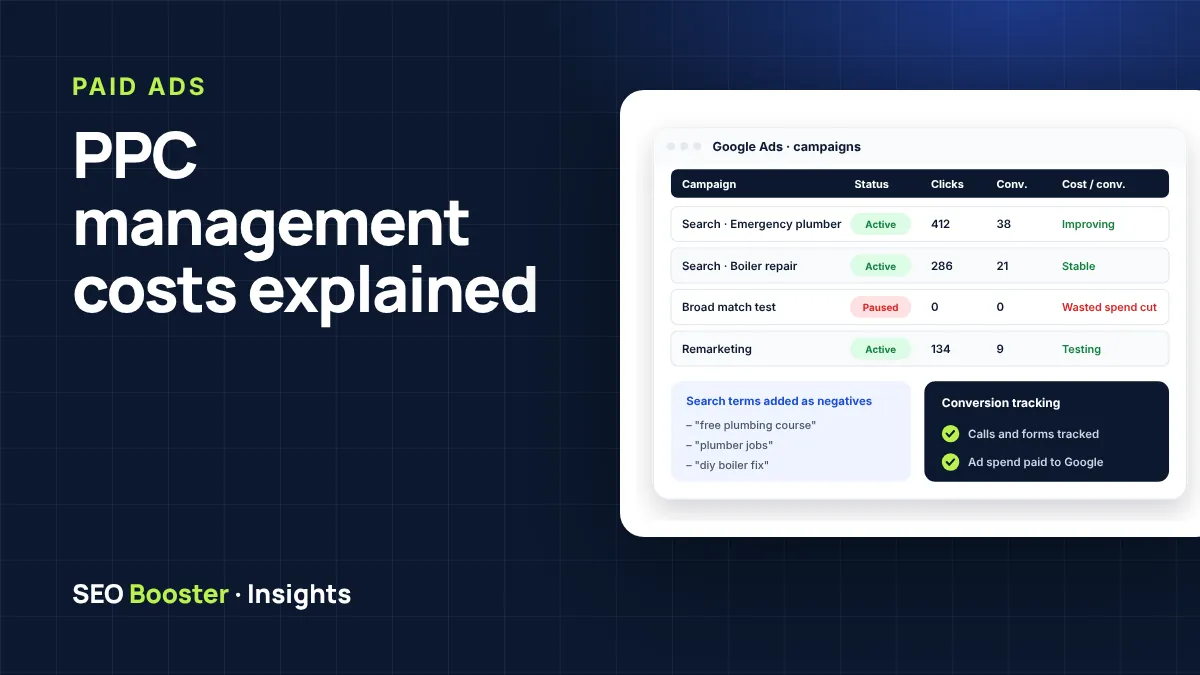
- Conversion tracking that works. Without it, optimisation is guesswork (Google Ads: about conversion tracking).
- Search term reviews. Irrelevant searches added as negative keywords every week.
- Ad testing. New ad copy tested against the current best performer.
- Budget and bid management moved towards campaigns that convert.
- Clear reporting showing spend, conversions and cost per result, not just clicks and impressions.
Signs your account is not being managed
- The change history shows almost no activity for weeks.
- Search terms include obviously irrelevant phrases.
- Every campaign uses broad match with no negative keywords.
- Reports show clicks and impressions but never conversions.
- You do not have admin access to your own ad account.
Start with an audit
If you already run ads, a Google Ads audit is the cheapest way to find wasted spend before paying for ongoing management. If you advertise on Facebook and Instagram too, see our Facebook ads management.
Questions to ask before hiring anyone
- Will the ads run in my own account, and will I have admin access?
- Exactly what work happens each week, and how will I see it?
- Is conversion tracking included, and who checks it is accurate?
- What is the notice period, and what happens to my account if I leave?
- Do you charge a percentage of spend, and if so, is it capped?
A good provider answers all five without hesitation. If the answers are vague, keep looking.
Frequently asked questions
What is a reasonable PPC management fee?
It depends on account size and complexity. For small accounts, flat monthly fees are usually clearer and better value than a percentage of spend.
How much should I spend on Google Ads?
Enough to get meaningful data, typically enough for at least 20 to 30 clicks a day in your main campaign. Start small, measure, then scale what converts.
Should I own my Google Ads account?
Always. Your account holds your data and history. Agencies should work in your account as users, not run ads from theirs.
How long before PPC campaigns perform well?
Expect a learning period of two to four weeks, then gradual improvement as search terms, bids and ads are optimised.
Want a second pair of eyes on your ads?
Our fixed-price Google Ads audit shows wasted spend, tracking gaps and the fixes in priority order.